analytics1_1
GBP/USD Trading Recommendations and Trade Analysis for July 27. The Pound Breaks the Downtrend
GBP/USD Trading Recommendations and Trade Analysis for July 27. The Pound Breaks the Downtrend
Trading plan
2026-07-27 02:47:05
Analysis of GBP/USD 5M
The GBP/USD pair did not show any significant growth on Friday, but it is worth noting that the British currency has not been stagnant in recent weeks, unlike the euro. By the end of last week, the pair failed to break through the area of 1.3301-1.3309, and on Monday morning, it settled above the descending trend line. All signs indicate that the downtrend on the hourly timeframe has concluded, and we are expecting a new uptrend. Overall, we continue to fully support any growth of the euro and the pound, as we believe that the dollar has long since absorbed all positive factors for itself. The geopolitical factor cannot continuously support the US currency. The market is simply reacting to the same events in a repetitive cycle. The Federal Reserve hasn't even begun raising the key rate yet, and the market has already priced in this event. On Friday, relatively positive business activity indexes in the services and manufacturing sectors were released in the UK, while a yearly flat persists on the weekly timeframe, suggesting further growth for the British currency.
From a technical standpoint, the British pound has broken the descending trend line, so it will likely aim to reach the Senkou Span B line, which serves as support for bears. Much will depend again on geopolitics, although the market continues to respond selectively to it. However, this week, the pound is inclined to rise.
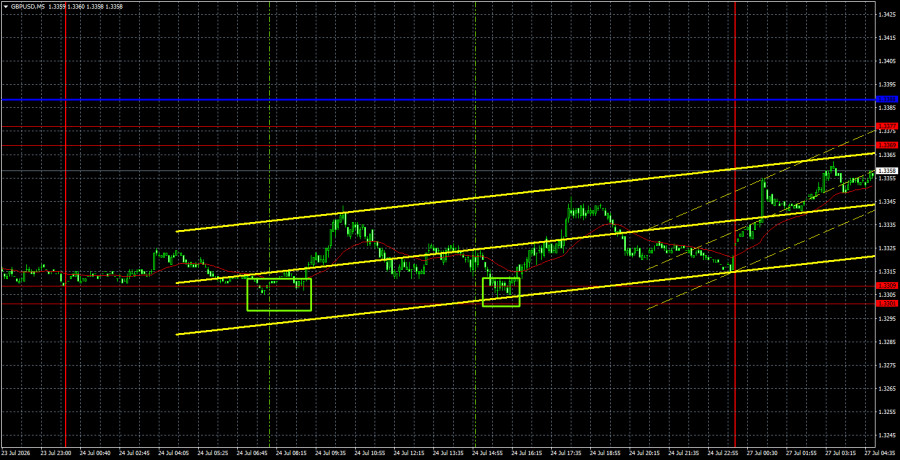
On the 5-minute timeframe on Friday, two buy trading signals were formed. First, during the European session, and then in the American session, the price bounced off the area of 1.3301-1.3309, allowing traders to open long positions. On Monday morning, the price nearly reached the area of 1.3369-1.3377.
COT Report
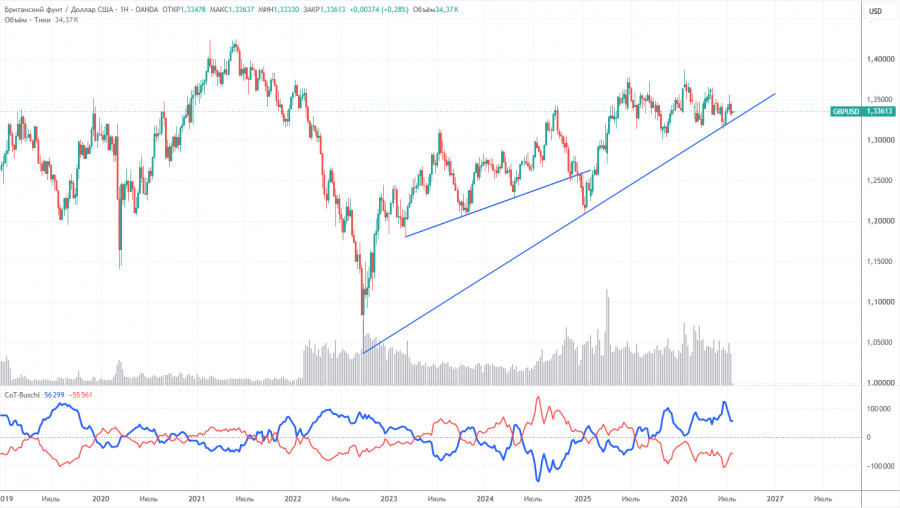
COT reports for the British pound show that non-commercial traders have dominated the market with sell positions for several months. The net position is negative, despite a long-term upward trend. Given the events in the Middle East, it is no surprise that demand for risk-sensitive currencies remains weak. The war is formally over, but the conflict continues. Geopolitics may support demand for the US dollar in the near term. However, until a consolidation below the trend line occurs, we would not expect a significant decline in the pair.
In the long term, the dollar will continue to decline due to Donald Trump's policies, as evidenced on the weekly timeframe (illustration above). The trade war will continue in one form or another for a long time, and Trump's policies aim directly and indirectly at weakening the US currency. The long-term upward trend remains, as evidenced by the trend line. The price recently tested this line and rebounded from it. According to the latest COT report (dated July 21), the "Non-commercial" group opened 13,200 BUY contracts and closed 2,500 SELL contracts. Thus, the net position of non-commercial traders increased by 15,500 contracts for the week.
Analysis of GBP/USD 1H
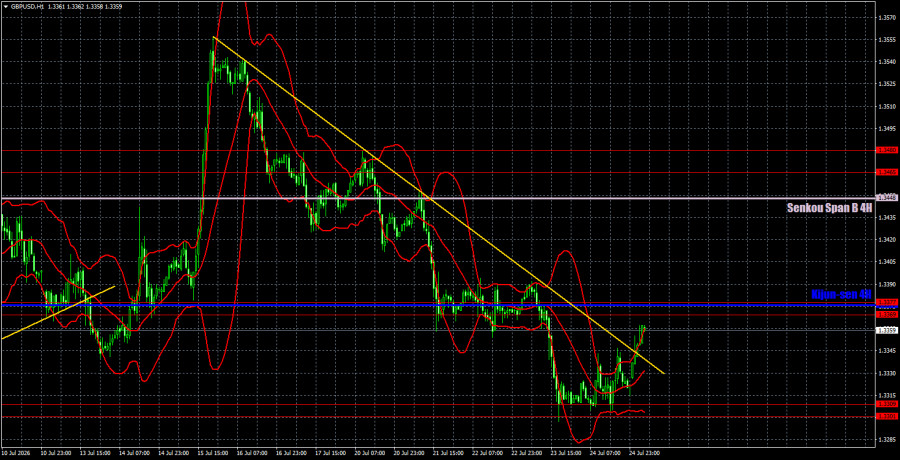
On the hourly timeframe, the GBP/USD pair has begun to form a new upward trend, or at least to start doing so, as indicated by technical analysis. If Tehran and Washington resume negotiations, this could help risk-sensitive currencies like the euro and the pound to rise in value. In the long term, both currencies are still looking upward and have been in sideways channels for a whole year. This does not negate the upward trend that began back in 2022.
On July 27, we highlight the following important levels: 1.3042-1.3050, 1.3096-1.3115, 1.3179-1.3187, 1.3301-1.3309, 1.3369-1.3377, 1.3465-1.3480, 1.3588, 1.3671-1.3681. The lines of Senkou Span B (1.3448) and Kijun-sen (1.3374) may also be sources of signals. It is recommended to set the Stop Loss to breakeven once the price moves in the correct direction by 20 pips. The Ichimoku indicator lines may shift during the day, which should be considered when determining trading signals.
On Monday, there is an absolutely minor business climate index to be released in the UK, while the US will issue a relatively important report on durable goods orders. The day began with a decline in the dollar, but it is unlikely to be strong and prolonged. Most likely, movements throughout the day will again be weak.
Trading Recommendations:
Today, traders may open short positions targeting the area of 1.3301-1.3309 if the price bounces from the area of 1.3369-1.3377. Long positions can be opened if the price consolidates above the area of 1.3369-1.3377, aiming for the Senkou Span B line.
Explanations for Illustrations:
Support and resistance price levels are thick red lines around which movement may end. They are not sources of trading signals.
The Kijun-sen and Senkou Span B lines are Ichimoku indicator lines transferred to the hourly timeframe from the 4-hour timeframe. They are considered strong lines.
Extreme levels are thin red lines from which the price has previously bounced. They serve as sources of trading signals.
Yellow lines indicate trend lines, trend channels, and any other technical patterns.
Indicator 1 on the COT charts shows the size of the net position for each category of traders.
Смотрите также