Overview of the EUR/USD Pair. August 4. Trump Continues to Play with Himself
Fundamental analysis
2026-08-04 02:13:45
The EUR/USD currency pair traded very calmly on Monday, hardly reacting to another batch of "mega-important news" of a geopolitical nature. If you closely follow events in the Middle East, you can predict further developments as well as any expert. After a series of mutual strikes initiated by Washington, there was a pause. During this pause, Donald Trump once again talked about negotiations and an agreement (what else remains for the leader of the White House?). Iran, in turn, denied any negotiations with the U.S. Thus, the imminent signing of an agreement exists only in the fantasies of the American president.
Iran's Foreign Minister Ismail Baghaei could very well change his title to "Chief Denier of Donald Trump's Statements." Almost any statement by Baghaei is aimed at refuting the remarks of the U.S. president. Just yesterday, Trump stated that an agreement on the Strait of Hormuz has been reached and that the "nuclear deal" will be ready "very soon." Therefore, new strikes against Iran are canceled—after all, diplomacy must be given a chance. Naturally, by the end of the week, it will turn out that there are no deals or agreements, Iran will once again strike at a vessel in the Strait of Hormuz, and the U.S. will "be forced" to strike back and resume military actions. After another series of strikes, Trump will offer Iran yet another, one hundred twenty-sixth "last chance" to return to the negotiating table, and so on in a circle.
Overall, we are increasingly inclined to believe that Iran has completely withdrawn from negotiations with Washington. In principle, Iranian officials have repeatedly stated that negotiations with the U.S. are futile, and that Trump's list of conditions amounts to ultimatums Tehran is unwilling to accept. Since the ultimatums from the American side do not change, there is no sense in new negotiations. What surprises us in this story is that the oil market constantly reacts to any "drip" of information into the market. On Monday, it became known about God's mercy: Trump's refusal of new strikes, and oil immediately dropped in price. In the afternoon, Iran denied reports of negotiations, and oil prices immediately rose.
What can the U.S. dollar, which still holds the status of a "safe asset," derive from all this? From our point of view, the American currency has extracted the absolute maximum from what was available in 2026. Geopolitics and the conflict in the Middle East cannot consistently drive new, higher dollar growth. Capital actively fled in the initial months of the war, and many investors redirected and redistributed their capital in connection with this event. But now, we are in the sixth month of confrontation. New attacks in the Middle East are no longer a surprise, and the capital that sought to "escape" did so long ago. Thus, we still do not see any grounds for medium-term or long-term growth of the American currency.
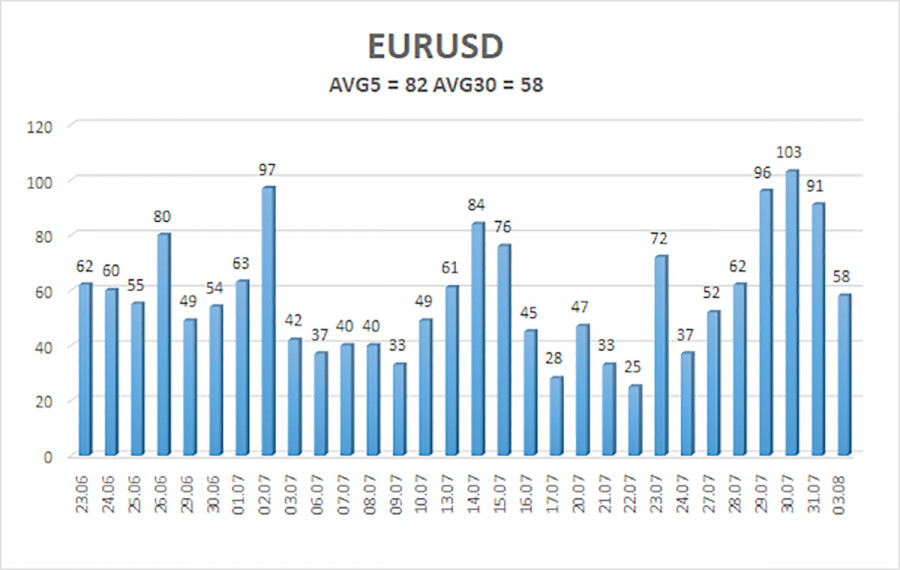
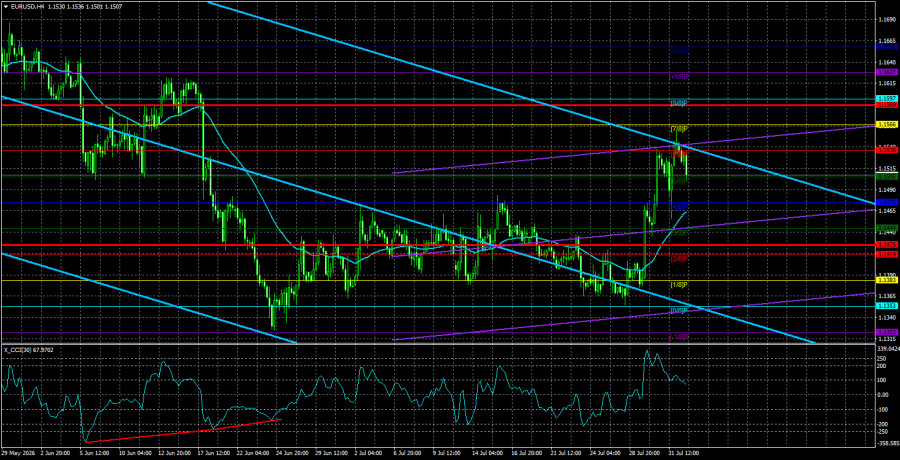
The average volatility of the EUR/USD currency pair over the last 5 trading days as of August 4 is 82 pips and is characterized as "average." We expect the pair to move between 1.1425 and 1.1589 on Tuesday. The upper linear regression channel is directed downward, indicating the continuation of the downward trend. The CCI indicator has entered overbought territory, signaling a possible downward correction.
Closest support levels:
S1 – 1.1505
S2 – 1.1475
S3 – 1.1444
Closest resistance levels:
R1 – 1.1536
R2 – 1.1566
R3 – 1.1597
Trading Recommendations:
The EUR/USD pair has begun a new upward trend on the 4-hour timeframe, which could mark the beginning of a new cycle of the global upward trend on higher timeframes. The global fundamental backdrop for the dollar remains negative, but in 2026, first geopolitics and then a hawkish stance from the Fed have provided strong support for the American currency. However, every fairy tale comes to an end sooner or later. With the price positioned below the moving average, shorts can be considered, targeting 1.1414 and 1.1383. Above the moving average line, long positions are relevant with targets of 1.1566 and 1.1589.
Explanations for the Illustrations:
- Linear regression channels help determine the current trend. If both are directed in the same way, it indicates that the trend is strong right now;
- The moving average line (settings 20,0, smoothed) determines the short-term trend and the direction in which trading should currently be conducted;
- Murray levels are target levels for movements and corrections;
- Volatility levels (red lines) indicate the probable price channel in which the pair will spend the next day based on current volatility readings;
- The CCI indicator entering the oversold territory (below -250) or the overbought territory (above +250) indicates that a trend reversal in the opposite direction is approaching.
Смотрите также