EUR/USD Review on November 10: What to Expect from the Inflation Report
Fundamental analysis
2026-11-10 05:32:21
The EUR/USD currency pair started the new week with gains. Most analysts immediately reported some progress in negotiations between Iran and the United States, mediated by Qatar. However, no actual progress has been made. Genuine progress would mean that both sides of the conflict are willing to make concessions. In the current situation, Iran continues to demand that Washington fulfill all the terms of the Memorandum of Understanding signed back in the summer, which was violated just two weeks later. Meanwhile, Trump continues to push for nuclear negotiations, while Iran remains unwilling to engage until its demands are met. As a result, the conflict has reached an impasse, leaving neither side with much room to maneuver. Further escalation is unlikely to achieve anything. Following the Republicans' defeat in the congressional elections, Donald Trump will find it extremely difficult to maintain pressure on Iran. Iran, meanwhile, has no significant leverage other than the Strait of Hormuz, which is becoming less important to the global energy market with each passing month.
Therefore, the modest appreciation of the euro on Monday was, in our view, unrelated to geopolitics. There were no macroeconomic releases during the day, and traders are currently showing limited interest in fundamental developments. It is worth recalling that the Fed, the Bank of England, and the ECB generally maintain a hawkish stance. The Fed's position could certainly be described as strongly hawkish, while the ECB's is relatively mildly hawkish, which could explain the euro's weakness in recent months. In practice, however, all three central banks continue to tighten monetary policy at roughly three-month intervals. Given that inflation continues to rise in almost every region, there is simply no room for any deviation from the tightening path.
Today, the United States will release its October inflation report, which could provide the market with another immediate reason to buy the dollar. Inflation is expected to rise to 3.8–3.9%. If the actual figure exceeds expectations, this could trigger further purchases of the US currency. The reasoning would be that the Fed's stance would become even more hawkish. This, in turn, would imply a greater number of key interest rate hikes, making the dollar more attractive. Once again, it does not matter that the ECB is also raising interest rates and is currently tightening policy even more aggressively than the Fed. The market simply needs a reason to buy the dollar.
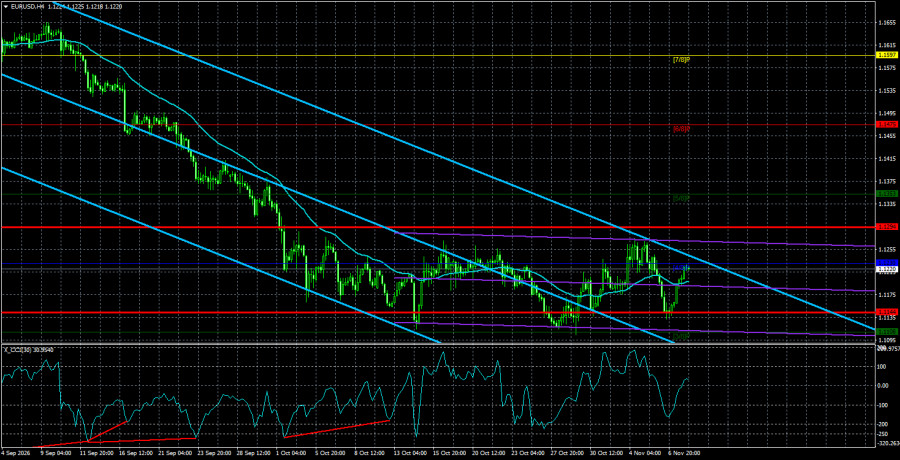
EUR/USD has been trading within the 1.1111–1.1267 sideways channel for more than a month. Yesterday, the price declined toward the lower boundary of the channel, making an upward reversal technically justified. The pair is now likely to move toward the upper boundary of the channel. As usual, the sideways movement may end when least expected. There are relatively few important events scheduled for this week, with US inflation being the main one. Traders are expecting increased volatility and new reasons to buy the dollar today. These expectations may be met. However, this will not strengthen the dollar's underlying potential for sustained long-term growth. On the longer-term chart, a correction against the global upward trend has been underway for a year. This correction will eventually come to an end.
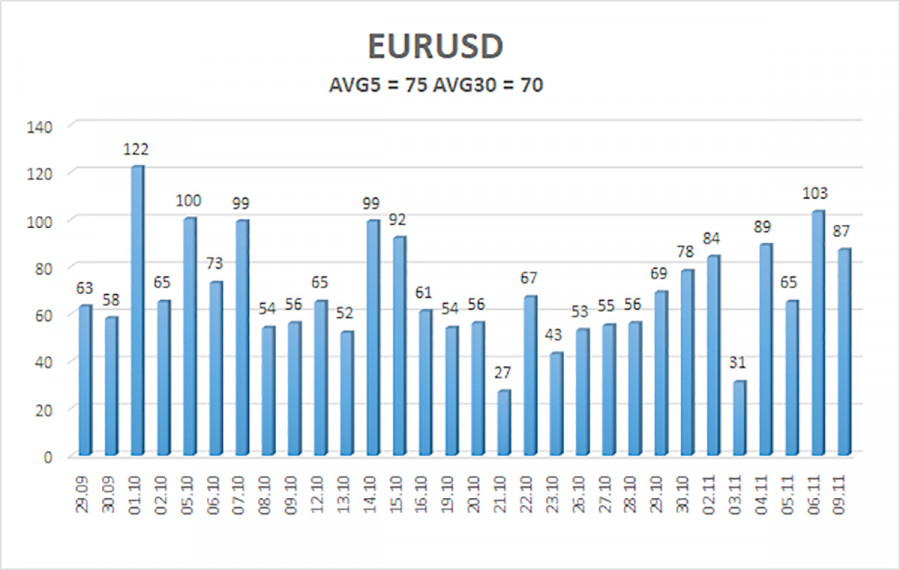
The average volatility of EUR/USD over the last five trading days as of November 10 stands at 75 points, which is classified as "average." On Tuesday, the pair is expected to trade between 1.1144 and 1.1294. The upper linear regression channel is pointing downward, indicating a downward trend. The CCI indicator has entered oversold territory five times and formed four bullish divergences, all of which have been ignored by traders. The irrational downward trend remains intact.
Nearest Support Levels:
S1 – 1.1108
S2 – 1.0986
S3 – 1.0864
Nearest Resistance Levels:
R1 – 1.1230
R2 – 1.1353
R3 – 1.1475
Trading Recommendations:
EUR/USD remains in a downward trend, although there are insufficient fundamental, macroeconomic, and geopolitical factors to support its continuation. The overall fundamental outlook for the US dollar remains negative. However, in 2026, geopolitical developments initially, followed by the Fed's hawkish stance, provided substantial support for the US currency. When the price is below the moving average, short positions may be considered with targets at 1.1144 and 1.1108. When the price is above the moving average, long positions remain relevant, with targets at 1.1294 and 1.1353. However, the pair must first break out of the 1.1114–1.1265 sideways channel.
Explanations for the Charts:
Linear regression channels help identify the current trend. If both channels point in the same direction, the prevailing trend is strong.
Moving average (settings: 20.0, smoothed) identifies the short-term trend and indicates the preferred trading direction.
Murray levels are target levels for price movements and corrections.
Volatility levels (red lines) indicate the probable price channel within which the pair is expected to trade over the next 24 hours, based on current volatility readings.
CCI indicator – when the indicator enters oversold territory (below -250) or overbought territory (above +250), it signals that a reversal in the opposite direction may be approaching.
Смотрите также