Who cares what Michael Saylor thinks?
Crypto-currencies
2026-11-23 05:34:31
Bitcoin and Ether continue the downward move that has turned into a full-blown crash. Recall that recent events for the crypto world have been uniformly negative. Central banks—notably the Fed—continue to tighten monetary policy, the Clarity Act remains only a bill, and Democrats won the U.S. congressional elections, further reducing the odds that the Clarity Act will become law. Two weeks ago, the list of headwinds grew with the hack of the world's largest crypto exchange, Binance. That was followed by a U.S. stock market crash and a rout in technology shares, which many experts closely link to Bitcoin's price. Then U.S. inflation accelerated more than forecasts, further boosting market hawkishness on Fed policy. The cherry on top was Nvidia CEO Jensen Huang's resignation, which prompted mass capital outflows from tech giants; then Nvidia was hacked, and hackers demanded a large ransom. Does anyone see a single reason to expect a rally?
That said, Bitcoin and Ether could show a rise in the near term—most likely only a corrective bounce. Bitcoin has swept liquidity at the previous daily low, which allows at least for a correction. Meanwhile, Michael Saylor again hinted at future Bitcoin upside and indicated that Strategy is ready to make new purchases of "digital gold." In a recent post on X, he wrote that "the story is not over." We do not doubt that Strategy will keep buying Bitcoin at any price. Over the last six years the company has effectively transformed from a software developer into a Bitcoin treasury. Purchases are made at any price and under any conditions. But that raises a simple question: who really cares what strategy plans to do if its actions are always the same?
Saylor does not repeatedly tell the market about new Bitcoin buys or future gains by accident. It does not matter whether Bitcoin is falling or rising; the former Strategy CEO will still announce buys and bullishness. But many traders and investors are willing to buy an asset when the fundamentals are supportive, not simply because Strategy keeps allocating all available funds to digital gold. Essentially the current picture is clear: only Strategy is buying; everyone else is selling, as spot exchange and ETF flow data show. Also understand that Strategy's Bitcoin investments are currently loss-making, and the company can hardly abandon its Bitcoin strategy now because it has become central to its operations.
Trading recommendations for BTC/USD:
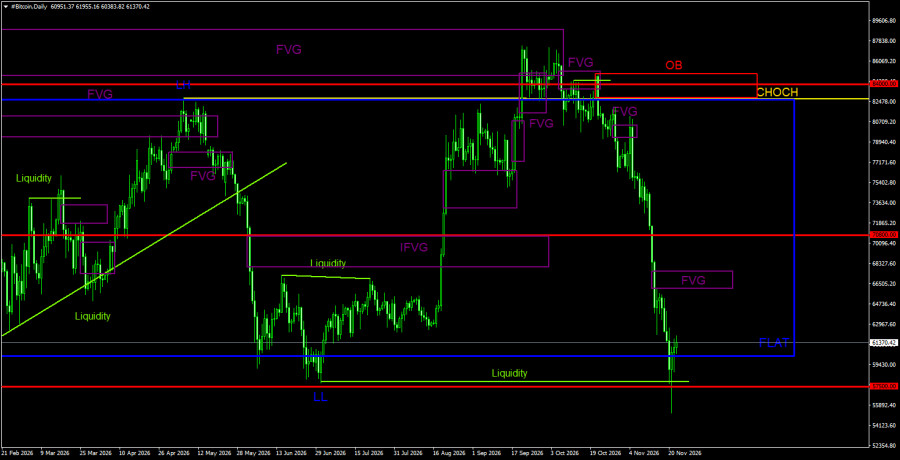
Bitcoin continues to form a long-term downtrend but may remain inside the daily sideways channel for now. Price formed a deviation of the flat's upper boundary and reacted to three bearish FVGs, which triggered the drop to the channel's lower boundary. All previously discussed targets have been reached. Around $60,200 and $57,500, a reversal up is possible, but talk of a bull trend is premature. If a lower boundary deviation of the channel forms, liquidity is swept from the previous low, and bullish patterns emerge, then long entries could be considered with targets at $70,800 and $84,000. However, the maximum Bitcoin can reasonably hope for now is the channel midpoint.
Trading recommendations for ETH/USD:
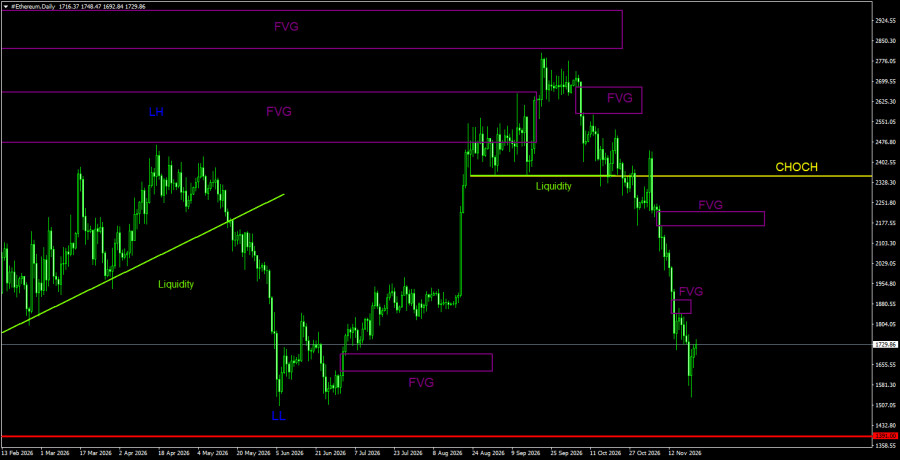
On the daily TF the technical picture for Ether has clarified—the bear trend remains intact. Two months ago, signs of a potential bull trend appeared, but we repeatedly warned that Ether's fate is in Bitcoin's hands. Bitcoin has produced enough sell signals and bearish patterns on the daily chart to explain the recent declines we ultimately observed. Thus, it is unsurprising that Ether also collapsed and may continue south following its "big brother." The nearest target is about $1,391, but Ether may fall much lower. Expect Ether's slide to finish only if Bitcoin forms a lower boundary deviation of the daily sideways channel.
Illustration notes:
CHOCH—change of trend structure.
Liquidity—liquidity, stop losses, and pending orders market makers use to build positions.
FVG—fair value gap. A price inefficiency area that price traverses quickly, indicating the absence of one side of the market; thereafter price tends to return and react to such areas in continuation of the main trend.
IFVG — inverted fair value gap. After returning to such an area, the price often does not react but impulsively breaks through and then tests from the other side.
OB — order block. The candle where a market maker opened a position aiming to take liquidity to form a position in the opposite direction.
Смотрите также