Bitcoin could lose 75% of its value
Crypto-currencies
2026-11-25 05:05:40
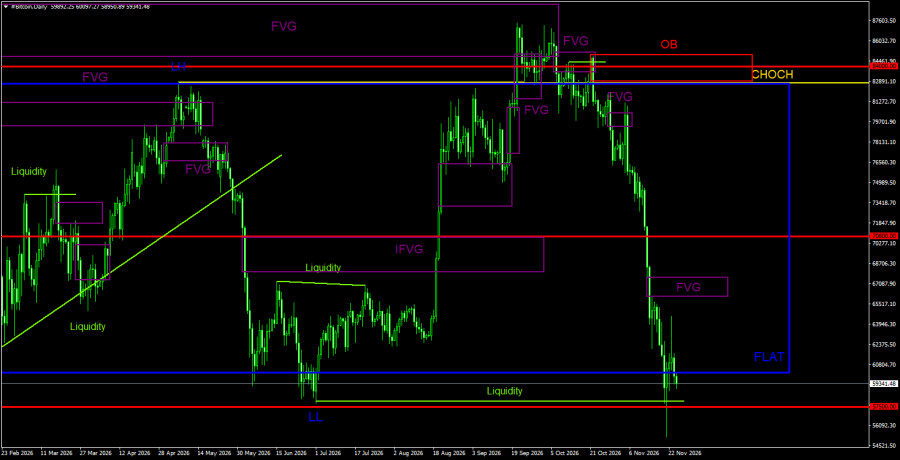
Bitcoin and Ether continue the downward move that has turned into a full-blown crash. At the moment the only thing holding digital gold back from further falls is the $57,500–$60,200 area, which serves as the lower boundary of the daily sideways channel. If that zone is breached, the global downtrend that began last year will resume—a trend the vast majority of crypto enthusiasts continue to deny. As we have said, Bitcoin currently lacks growth drivers. The situation is a little like the U.S. dollar: the dollar has no strong or at least sufficient reasons for a three-month rally, yet the market buys it so it rises. Demand for Bitcoin is falling, so it does not matter whether there are fundamental reasons to buy it now—there are none. Even Jensen Huang's return as Nvidia CEO sparked only a small, already faded crypto rally.
Meanwhile, futures trader Peter Brandt, who regularly issues crypto forecasts, said Bitcoin could lose 75% from its last all-time high. Brandt noted that every prior Bitcoin bull cycle ended with a decline of at least 75%. Of course he cites a "historical pattern," and as we know, patterns do not work forever. Nevertheless, history can repeat. By calculation, Bitcoin could fall to around $31,500, and 75% is only the minimum correction observed in prior cycles. Recall Bloomberg analyst Mike McGlone even predicts a drop to $10,000—or at least allows for it.
At the same time, Classnode noted that in previous cycles Bitcoin fell by 75%–93%, which indeed allows for a decline toward $10,000. Given the complete lack of growth drivers, we fully admit the drop may continue. We remind readers that Bitcoin has no intrinsic value of its own; its price is not determined by mining costs or by some rule that it must double every four years to keep mining profitable. Its price is set by market sentiment.
Trading recommendations for BTC/USD:
Bitcoin continues to form a long-term downtrend but may yet remain within the daily sideways channel. Price formed a deviation of the flat's upper boundary and reacted to three bearish FVGs, which triggered the drop to the channel's lower boundary. All the targets we discussed have been reached. Around $60,200 and $57,500 a reversal up is possible, but talk of a bull trend is still premature. If a lower boundary deviation forms, liquidity is swept from the prior low, and bullish patterns emerge, then long entries can be considered with targets at $70,800 and $84,000. However practically, the best Bitcoin can hope for now is the channel midpoint.
Trading recommendations — ETH/USD:
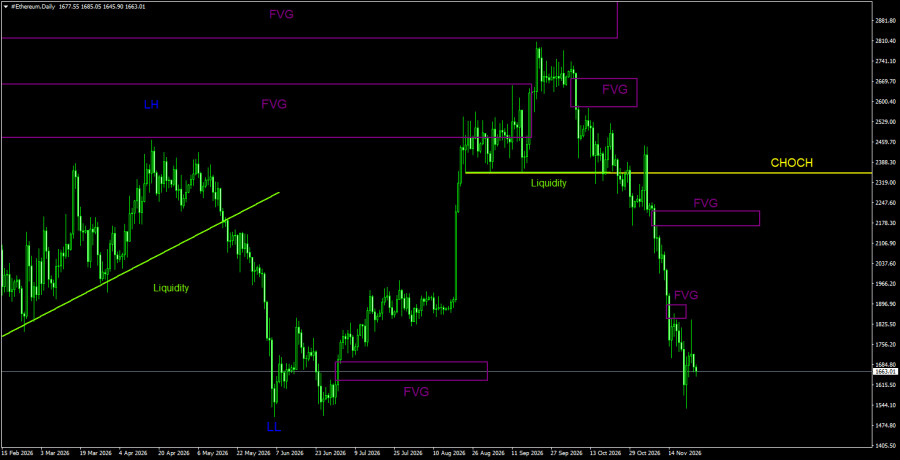
On the daily TF the technical picture for Ether has clarified—the bear trend remains. Two months ago signs of a bull trend appeared, but we repeatedly warned that Ether's fate lies in Bitcoin's hands. Bitcoin formed enough sell signals and bearish patterns on the daily chart to produce the decline we observed. Thus, it is unsurprising Ether also collapsed and may continue south in Bitcoin's wake. The nearest target is about $1,391, but Ether could fall much lower. Expect Ether's decline to end only if Bitcoin forms a lower boundary deviation of the daily sideways channel.
Illustration notes:
CHOCH—change of trend structure.
Liquidity—liquidity, stop losses, and pending orders market makers use to build positions.
FVG—fair value gap. A price inefficiency area that price traverses quickly, indicating the absence of one side of the market; thereafter price tends to return and react to such areas in continuation of the main trend.
IFVG — inverted fair value gap. After returning to such an area, the price often does not react but impulsively breaks through and then tests from the other side.
OB — order block. The candle where a market maker opened a position aiming to take liquidity to form a position in the opposite direction.
Смотрите также