Cryptocurrency Trading Recommendations – August 5 (U.S. Session)

Crypto-currencies
2026-08-05 11:13:29
Bitcoin continues to hold yesterday's gains, trading above $64,000 and appearing poised to extend its rally following a prolonged period of consolidation. Ethereum remains above $1,850 but below the key psychological level of $1,900.
As this market structure continues to develop, it is worth revisiting a well-known historical trading principle based on Bitcoin's four-year halving cycle. At present, it once again points to a potential buying opportunity. The "500-Day Rule," popularized online, suggests buying Bitcoin approximately 500 days before a halving event and selling it roughly 500 days afterward—a strategy that has historically generated returns of up to 34 times the initial investment. According to this theory, market bottoms have formed, on average, 477 days before each halving, followed by the beginning of a new upward trend, while the peak of the subsequent bull cycle has typically occurred around 480 days after the event itself. Based on the most recent halving on April 20, 2024, the next accumulation window is expected to open toward the end of November this year, while the theoretical sell signal would arrive around mid-August 2029.
However, the mechanism underlying this pattern may fail during the current cycle. This is the first Bitcoin halving cycle to take place with U.S. spot Bitcoin ETFs already established, whose daily inflows can exceed the value of newly mined coins. As a result, institutional demand and the broader macroeconomic environment now play a greater role than the reduction in new supply itself. The amount of new Bitcoin entering circulation through mining has become negligible compared with inflows into spot ETFs and purchases by corporate treasuries. Moreover, it was outflows from spot Bitcoin ETFs that marked both this year's market top and the subsequent reversal.
Nevertheless, not everyone is ready to dismiss the pattern. Until proven otherwise, the four-year cycle remains a structural anchor of Bitcoin's market dynamics, having persisted for the past 15 years. Its foundation lies in miners' economics, which help establish the market's price floor and trigger the systematic capitulation of weaker participants. This is consistent with the recently observed wave of miner capitulation, during which mining difficulty declined by nearly 20% from its peak while mining companies increasingly shifted their focus toward AI infrastructure. In any case, the validity of this rule can only be fully confirmed or disproven by 2029.
As for short-term trading, the strategy and trading scenarios are outlined below.
Bitcoin
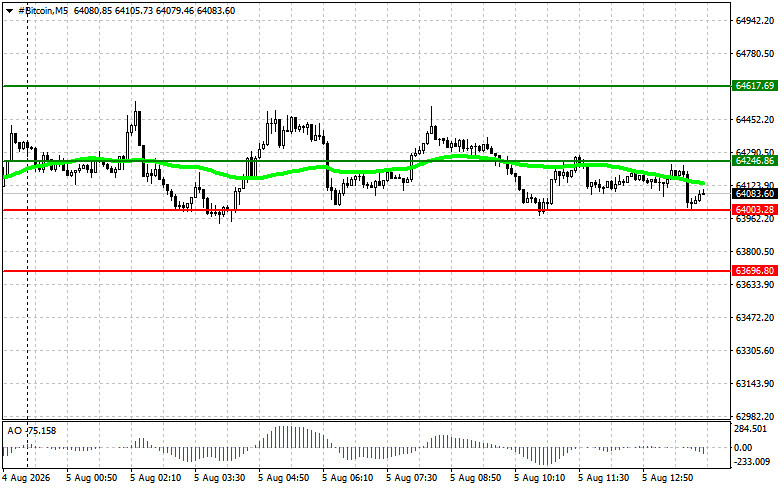
Buy Scenario
Scenario #1: I will buy Bitcoin today if the price reaches the entry point around $64,200, with a target at $64,600. I plan to exit long positions around $64,600 and immediately open a short position on a rebound. Before buying on the breakout, make sure that the 50-day Moving Average is below the current price and that the Awesome Oscillator is above the zero line.
Scenario #2: Bitcoin can also be bought from the $64,000 support level if there is no bearish market reaction following a false breakout, targeting $64,200 and $64,600.
Sell Scenario
Scenario #1: I will sell Bitcoin today if the price reaches the entry point around $64,000, with a downward target at $63,400. I plan to exit short positions around $63,400 and immediately open a long position on a rebound. Before selling on the breakout, make sure that the 50-day Moving Average is above the current price and that the Awesome Oscillator is below the zero line.
Scenario #2: Bitcoin can also be sold from the $64,200 resistance level if there is no bullish market reaction following a false breakout, targeting $64,000 and $63,600.
Ethereum
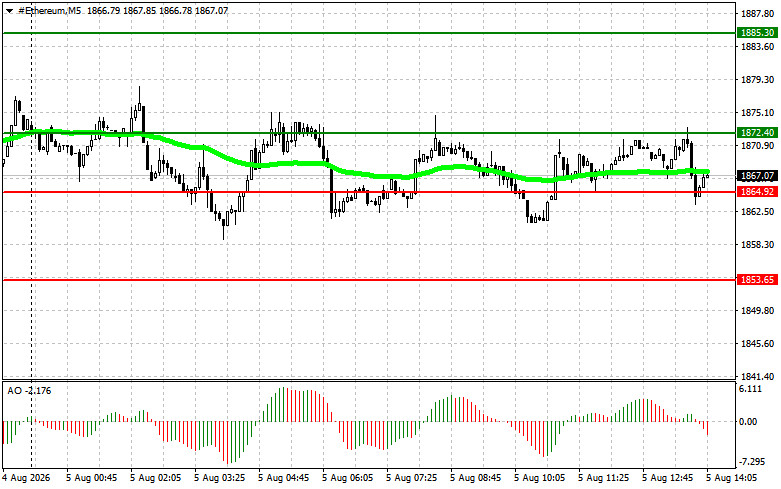
Buy Scenario
Scenario #1: I will buy Ethereum today if the price reaches the entry point around $1,872, with a target at $1,885. I plan to exit long positions around $1,885 and immediately open a short position on a rebound. Before buying on the breakout, make sure that the 50-day Moving Average is below the current price and that the Awesome Oscillator is above the zero line.
Scenario #2: Ethereum can also be bought from the $1,864 support level if there is no bearish market reaction following a false breakout, targeting $1,872 and $1,885.
Sell Scenario
Scenario #1: I will sell Ethereum today if the price reaches the entry point around $1,864, with a downward target at $1,853. I plan to exit short positions around $1,853 and immediately open a long position on a rebound. Before selling on the breakout, make sure that the 50-day Moving Average is above the current price and that the Awesome Oscillator is below the zero line.
Scenario #2: Ethereum can also be sold from the $1,872 resistance level if there is no bullish market reaction following a false breakout, targeting $1,864 and $1,853.
Смотрите также