Mining last million Bitcoins could take hundred years
Crypto-currencies
2026-09-29 06:52:56
Bitcoin and Ethereum have made another surge and are getting closer to a full-fledged bull trend. We still cannot pinpoint the reasons for the latest sharp rise in digital assets. Notably, the two most important recent events for the crypto world were actually negative rather than positive. Central banks (notably the Federal Reserve) began tightening monetary policy, which increases demand for safe assets like bank deposits and government bonds. The Clarity Act, the bill intended to regulate digital-asset investing in the US, again failed to clear Congress. By logic, the crypto market should have fallen rather than posted a new explosive rally. However, as we warned earlier, pumps do not need reasons, and there is no logic to them.
Meanwhile, experts have calculated that fewer than one million Bitcoins remain available to mine out of the total 21 million issuance. According to their estimates, if mining rates do not change, mining the last million will take more than 100 years. Recall that miner rewards are cut roughly every four years — a phenomenon called "halving." The next halving is scheduled for 2028. Over time, mining rewards will fall to such minimal levels that many miners will leave the market. Each Bitcoin is divisible into 100 million satoshis, and to obtain a few tenths of a Bitcoin in about 50 years, its price would have to be many times higher than today's. In short, Bitcoin would need to demonstrate perpetual growth for mining to remain economically viable.
Since most coins are already in circulation, and Bitcoin is unlikely to double at least every four years, we believe mining volumes will gradually decline. Already today, the AI sector offers clearer and more stable returns for using compute and power capacity. Miners have begun, at a minimum, allocating their capacity between AI workloads and Bitcoin. We expect this process to intensify over time. Is that good or bad for Bitcoin? On one hand, the supply of new coins falls each year. On the other hand, demand for Bitcoin would need to continuously rise for its price to increase. We think that process cannot continue forever.
Trading recommendations for BTC/USD
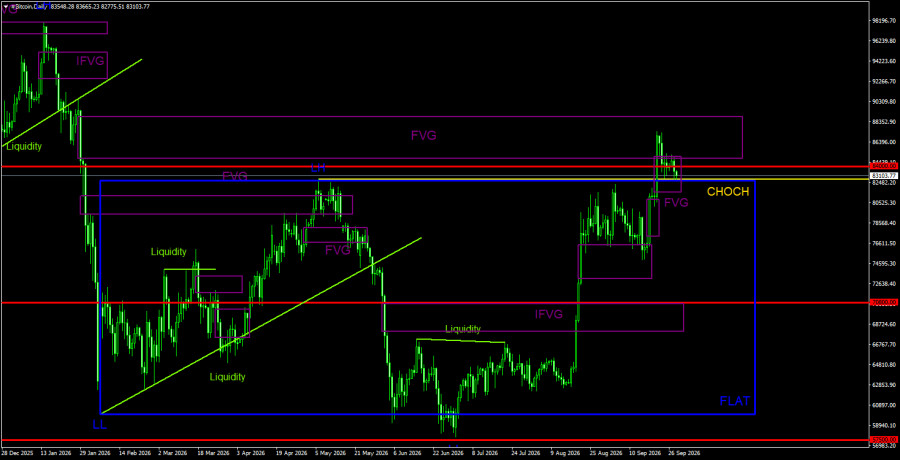
Bitcoin shows all the signs of the start of a new bull trend. This trend begins, as usual, with a pump that has no concrete or clear reasons. The Federal Reserve has not started cutting interest rates, and the Clarity Act was not passed. In the near term, on the daily timeframe, Bitcoin may be in decline, as price has reacted to a bearish FVG. We also note for traders that the current breakout of the daily consolidation channel may be a deviation — yes, a deep deviation, but still a deviation. If so, bitcoin can still fall back to $57,500. On the 4-hour timeframe, both long and short positions can be considered, but the most relevant pattern now is bearish.
Trading recommendations for ETH/USD
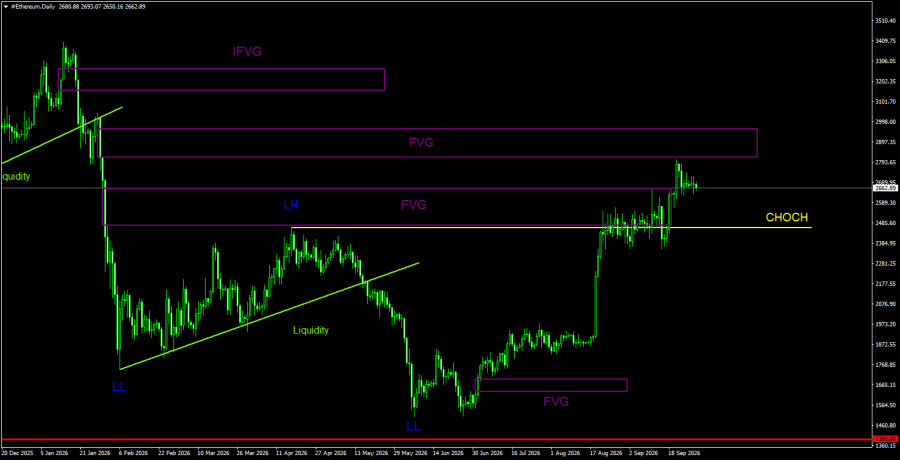
On the daily timeframe, the technical picture for Ethereum changed completely in just a few days. Ethereum is now looking toward a new uptrend. However, traders should base decisions on the weekly chart, where Ethereum is headed for $4,800 — the upper band of a five-year sideways channel. On the daily chart, the first bearish FVG did not produce a notable price reaction; the next FVG might. Bitcoin filled the nearest bearish FVG on the daily chart, so both cryptocurrencies may be in a correction in the near term. The recent rise in digital assets has been driven solely by a pump. There are currently more fundamental reasons for a drop in both cryptocurrencies than for further growth.
Comments on the charts
CHOCH is a change of character / break of the trend structure. Liquidity means traders' Stop-Losses that market makers use to build their positions. FVG stands for a Fair Value Gap (area of price inefficiency). The price often moves quickly through such areas, indicating the absence of one side in the market. Later, the price tends to return and react to these zones. IFVG is an Inverted Fair Value Gap. After a return to such a zone, the price does not react but impulsively breaks through and then tests it from the other side.
OB means an Order Block. A candle on which a market maker opened a position in order to harvest liquidity and then form their own position in the opposite direction.
Смотрите также